Featured

Mango among ‘mango people’

– The king of fruits in the sunshine state of Goa –

It’s the mango season. Amche Goa (My Goa), you can spot mangoes everywhere—from bustling street vendors to backyard farms, all celebrating the arrival of the Toranche season as we lovingly call the mango season in Goa. One can see mango trees loaded with ‘amboli’ (raw mangos) everywhere. Goans love mangos in every form and even add them in the local Goan cuisines. Best way to enjoy this juicy, delicious fruit is in all its natural glory. Nothing beats the flavour of an Alfonso or Mancurad of Goa.
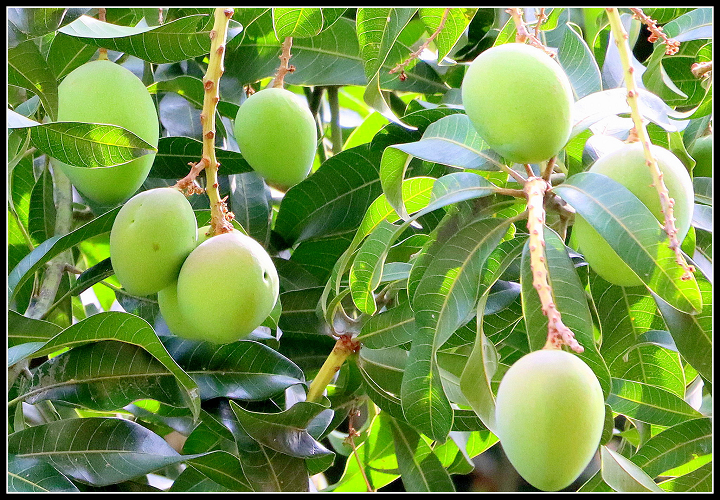
Mango tree loaded with raw mango – a specialty in itself. (pic courtesy – Flikr)
Mango Harvest in Goa

Salcette, Sanguem and Canacona are the top-three mango cultivating talukas(areas) followed by Bardez and Tiswadi. Salcete is known for its fertile orchards and wide mango variety, Sanguem is a major contributor to Goa’s mango output while Canacona is home to traditional, organic mango growers. Bardez has the advantage of early mango harvests, while Tiswadi offers rare and heritage mango types. These regions provide ideal soil and climate for cultivating high-quality mangoes.
The Alphonso and Badami varieties originate from Siolim in Goa. Mangoes tend to ripen naturally in the summer heat of April and May. First to come are the Khalmi, Pyari, and Kayri. These are the raw mangoes variety available for about Rs. 500-600 per dozen. The other variety is the Badami which is available at Rs. 300 per dozen. The most expensive mango, however, is the Mancurad, priced at ₹1500–₹2000 per dozen, followed by Alphonso (hapus) ₹800–₹1,300 per dozen. Finally, Sindhuri is available at ₹200–₹220 per kg, and the cheapest is the Totapuri at ₹180 per kilogram.
Because our love for mango is so deep-rooted, let’s go back a little and take a glimpse into the past of the arrival of mangoes in Goa.

Goa and Mangoes: A glimpse into the past
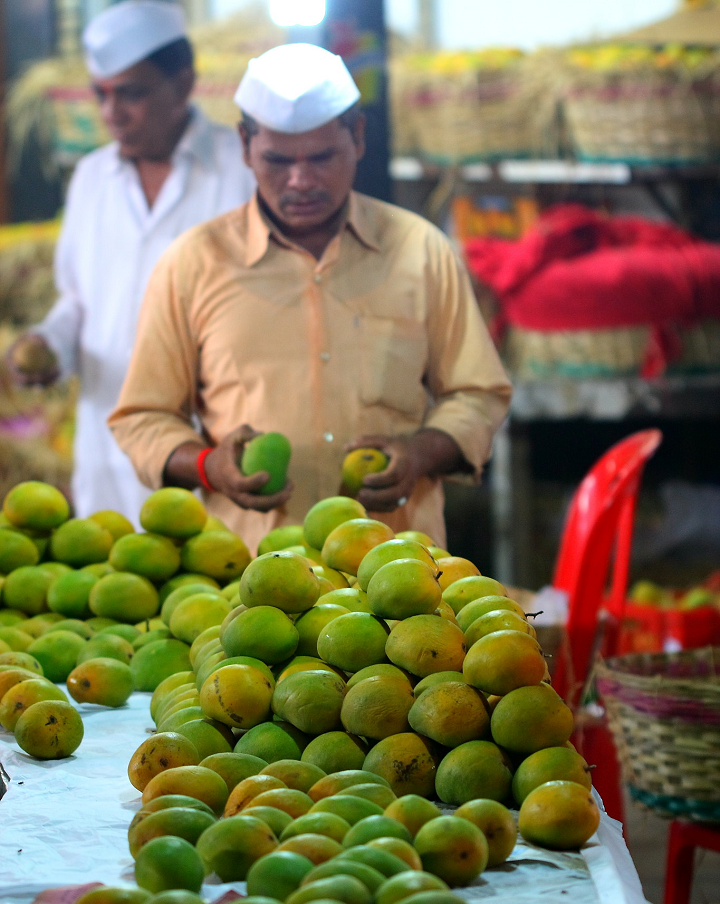
The history of mangoes in India dates back over 4,000 years, with references found in ancient texts like the Vedas and Upanishads. In many Indian cultures, mangoes symbolize prosperity, love, and even divine blessings. But while India as a whole embraced the mango early on, Goa’s deep-rooted relationship with the fruit began later—thanks to colonial influence.

When Vasco da Gama discovered the sea route to India in 1498, it opened the gates to a wave of Portuguese explorers, traders, and missionaries. By 1510, under the leadership of Afonso de Albuquerque, the Portuguese had conquered Goa, transforming it into a strategic and cultural hub of their eastern empire.

As the Portuguese settled, they introduced several new crops and culinary practices to the region—including cashews, pineapples, and mango saplings. Mangoes were in great demand across Europe for their exotic sweetness and vibrant color, and Goa offered ideal agro-climatic conditions for cultivation:
• Laterite-rich soil
• Warm, humid tropical weather
• Consistent monsoon rainfall
The Portuguese began systematic grafting and hybridization techniques, improving native mango strains and developing more robust, flavorful varieties. This is how Goa came to host some of the most unique and heritage mangoes in India—like the beloved Mancurad (originally called Malcorado, meaning “poorly colored” in Portuguese).
Over the centuries, mangoes integrated into Goan culture and cuisine, appearing in local dishes, religious rituals, and summer celebrations. From raw mango curries to sun-dried pickles, mangoes became more than just a seasonal fruit—they became an emotional and cultural staple.
Today, the mango’s journey from Portuguese cargo to Goan backyard trees stands as a testament to how colonization, climate, and culinary curiosity shaped one of Goa’s sweetest traditions.

Variety of Mangoes available in Goa

The variety of mangoes grown in the sunshine state is over 100. It is called the “King of fruits” for a reason. One can experience different tastes, textures, sizes and names that many haven’t even heard of, let alone the taste.
The most famous and widely available types of mangoes are the following:

Mankurad Mango
Also known as Goa Mankur, Kurad, Malcorado, Corado etc., Mankurad is the most popular variety available throughout Goa. The connect goes long back into history. The Portuguese named it Malcorado, meaning ‘poor coloured’. As time passed, the locals started calling it the ‘Mankurad’.
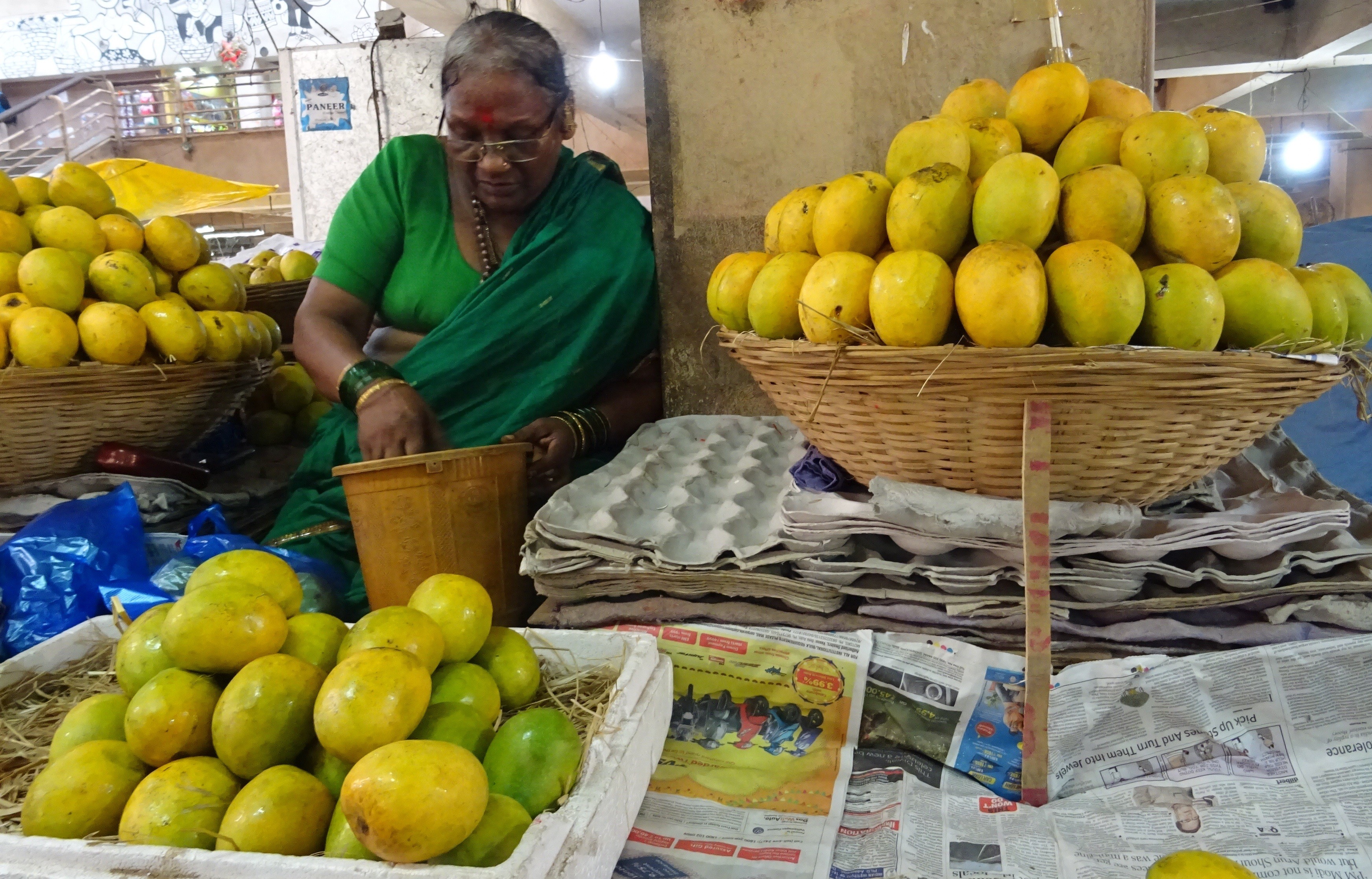
Fresh Mancurad mangoes in a traditional Goan market basket
The mighty Mankurad Mango (pic courtesy Flickr)

Malgesh
This version, also known as Malgesta, Malgessa, Malgueso and Malgess is popular in North Goa with wide variations in fruit colour, size and quality. The name means ‘difficult to digest’ in Portuguese. The two types recognised are Khand Malgesh – a thick-skinned inferior quality and Akno Malgesh – a superior quality.

Culas
This variety is famous throughout Goa. Many people like its peculiar flavour which is tangy and not too sweet. A lot of variation exists in this variety.

Afons
This variety of mango is also known as Goa Appus or Goa Alfonso. However, it is fast disappearing as the Ratnagiri Alfonso is preferred by many mango lovers. The Ratnagiri Alfonso is of better quality as far as the shelf life is concerned and is gaining popularity.

Hilario
The Hilario mango, also known as Mang Hilario, Mangilar, Mangilal etc., enjoys the same position as Mankurad and is hugely popular in North Goa. It fetches a reasonable price in the market as it tastes delicious. The tree that fruits Hilario is said to have originated in the garden of one Hilario Fernandes of Siolim in the Bardez taluka, henceforth the name. It is a variety that arrives late, with fruits maturing even up to July. Hence, it is a variety that arrives when no other good mango varieties are available.

Mussarat
Popularly cultivated in North Goa, Mussarat or Monserrate de Bardez is named after the Bardez taluka, where it originated. The immature fruits of this variety exhibit an intense red colour. This variety of mango is used to prepare jams, sweet pickles and processed products.

Fernandin
The Fernandin mango, also known as Fernandina, is very popular because of its taste. Best part about this variety is that doesn’t get spoiled because of moisture during rains or even fruit flies.

Xavier
This variety of mango is known for its sweetness and juicy flavour. It is planted throughout the state and is marketed both in North and South Goa. Both fibrous and non-fibrous forms exist.

Local Markets in Goa to buy the best mangoes

So, the question is; where do we find the tastiest mangoes in Goa? Here are our top picks for some of Goa’s best places to buy mangoes.

The Goan Farmers Market, Margao
The Goan Farmers Market organised in Margao in South Goa aims to promote the local Goan produce. If you want to buy some good quality mangoes, visit this market for fresh local right from the farm, homemade products and more. The Goan Farmers market is a great place to shop for mangoes grown by fellow Goans in their backyard.
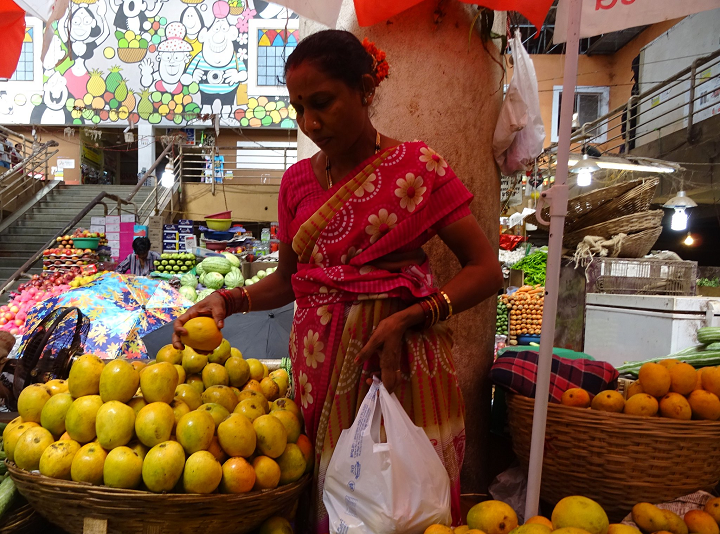
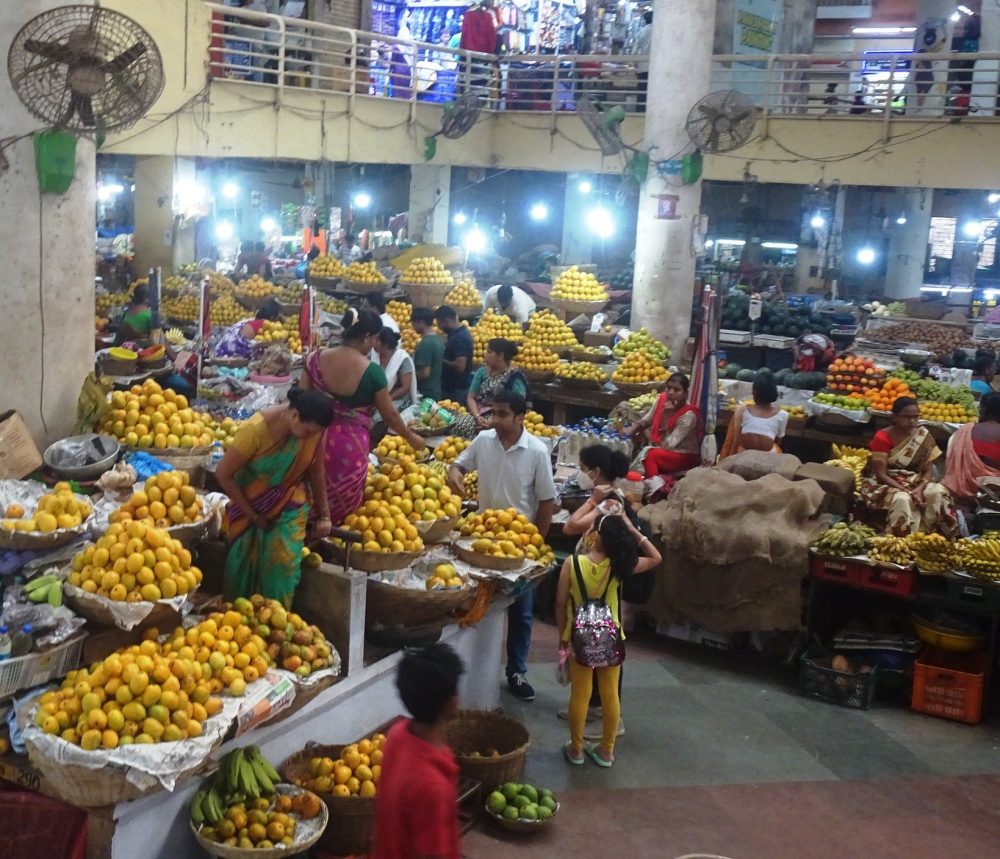
markets filled with fresh mango produce
Seller surrounded with Mango varieties (pic courtesy Flickr)

Panjim Market in Goa
The Panjim Market, run by the Panjim Municipality, is one of the largest local markets in Goa. So, if you’re all prepped to buy fresh mangoes from Goa, this is the place to be. The sweet-scented aroma of Goan mangoes fills the market. You could even get to try something you’ve never seen before. The friendly vendors will be more than happy to give you a sample. The massive mural of the Mario Miranda painting in Panjim Market adds to the galore of buying the best mangoes in Goa.

MMC New Market in Margao, Goa
The Margao New Market is one of Goa’s most recommended street markets. It is an excellent place to buy locally produced vegetables and fruits, especially mangoes. The market buzzes with loud vendors and the fragrance of the fresh vibrant fruits and veggies. Bargaining is the added perk when you visit the MMC market. But it is wise to be on the lookout for reasonable pricing and quality fruit if you are a tourist. The best option is to shop with a local friend.

JR Farm, South Goa
The farm produces various organic, fresh harvest in South Goa and supply to the state and customers on request. They will bring to your home the loveliest, tastiest, and pulpiest mangoes that are organically grown with lot of love on their farm.

The sweetness of this wonderous fruit is undeniably loved by all human. That’s how I would like to believe. One cannot go without cherishing the drool-some flavour of a mango. And Goa has some amazing variety to offer. So, when you are visiting the sunshine state, don’t forget to experience the king of fruits in raw or cooked form.

Tip: the title says ‘mango people’ – in India people call ordinary people – ‘aam aadmi’ in Hindi. ‘Aam’ here means ordinary and also Mango.
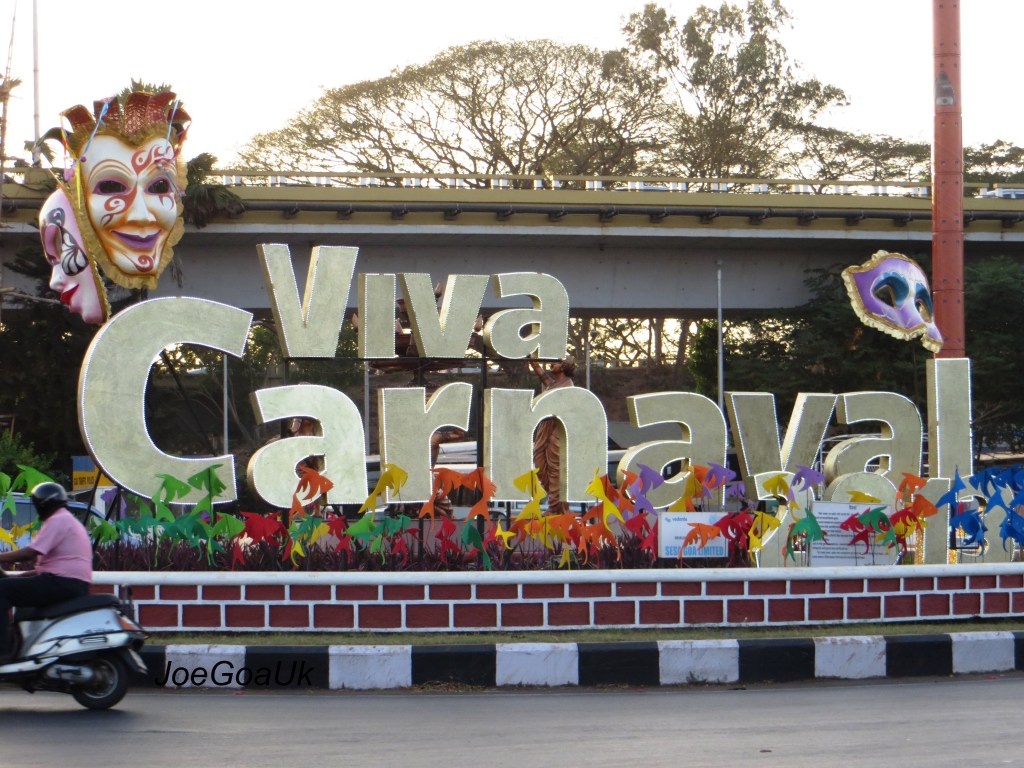
Best time to visit Goa is from October till February. It is very pleasant and worth basking in the sun. If you are in Goa in February, enjoy the Goa Carnival as it happens.
Featured

A very ‘Feni’ story!

By Nidhi Lall

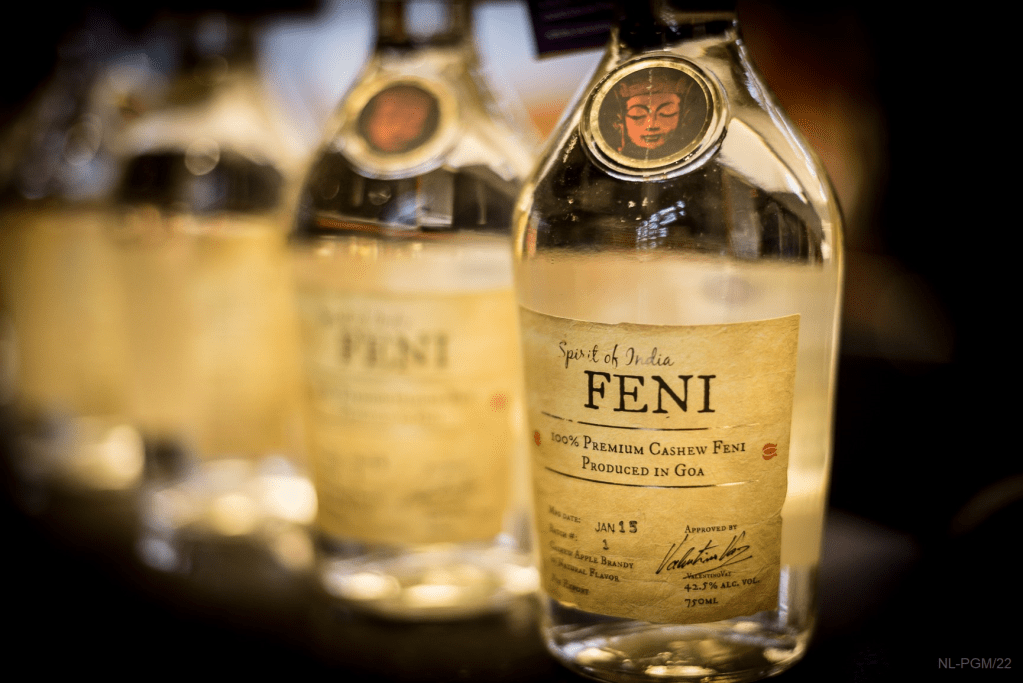
In one of his interviews, Mario Miranda – Indian cartoonist and painter – was asked to describe Goa, and he said – “It is a land of Feni and harmony.” These words describe the soul of Goa. Today, with a history belonging to the Portuguese era – Feni – adorning the crowned as the ‘Heritage Spirit’ of Goa is reviving and paving its way back.

With the onset world over lockdown due to the pandemic, three days after the first batch of cashew apples arrived, the big distilleries in the state were shut. It halted, among other things, the production of alcohol. Feni, a heritage liquor of Goa, could not be distilled. Discussions with the state happened, divided on whether Feni and Urak, the liquid after the first distillation, to be promoted as food products or alcohol.

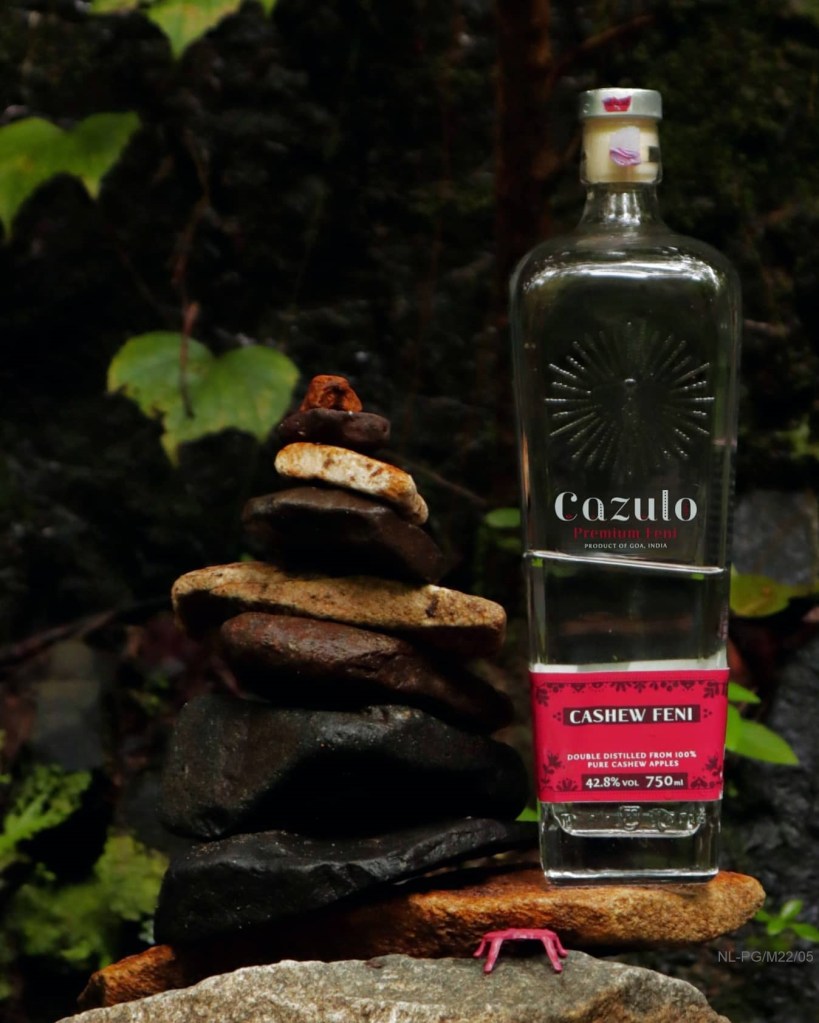
Feni - Heritage Spirit of Goa
Feni – The soul of Goa and the Heritage Spirit of India

This year, deeply missed by Goans, Feni made a befitting come back through Festivals and Wine & Cocktail events.

Let’s take a rendezvous along with the soulful drink of Goa – Feni.

A Brief History of Feni

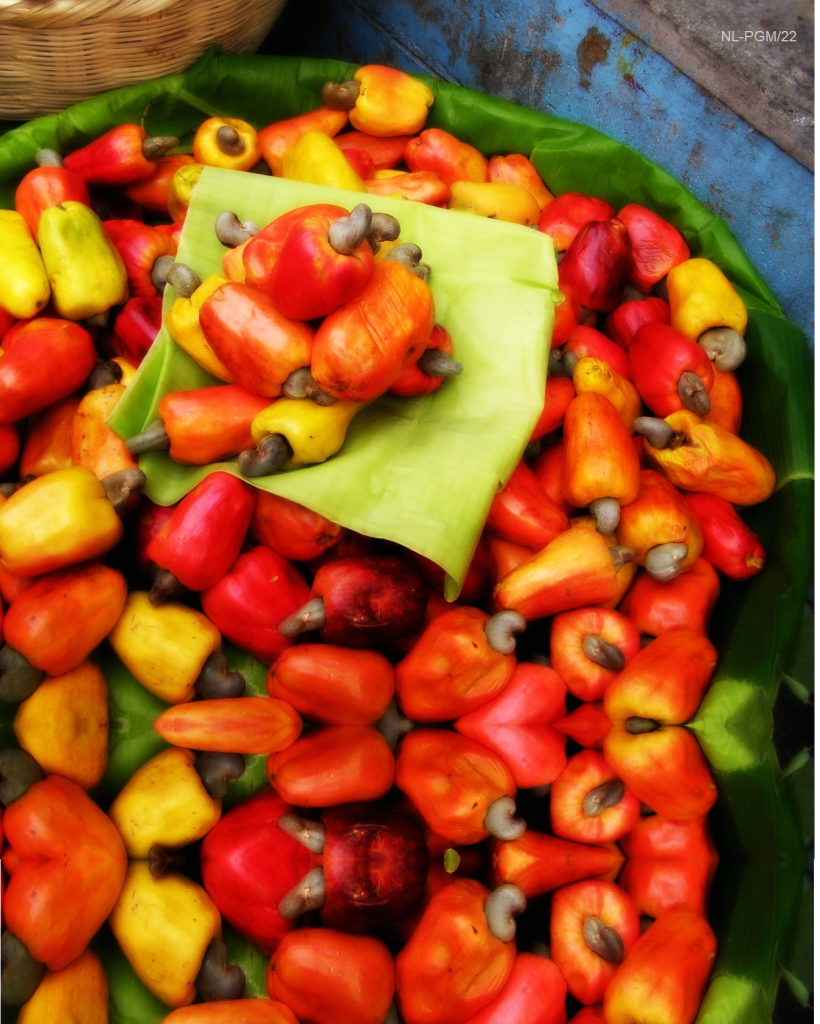
Goa’s state drink Feni is made from cashew nuts. Feni derives its name from the Konkani word “froth”. It used to be consumed as a shot by the Goan working class. They juggled the foam between two coconut shells, mixing it well enough to get the desired kick. Later Feni made a comeback at Goan weddings as a more refined drink in a new avatar. The fermented fruit is put through three stages of distilling in earthen or copper pots, yielding three different drinks at each stage.

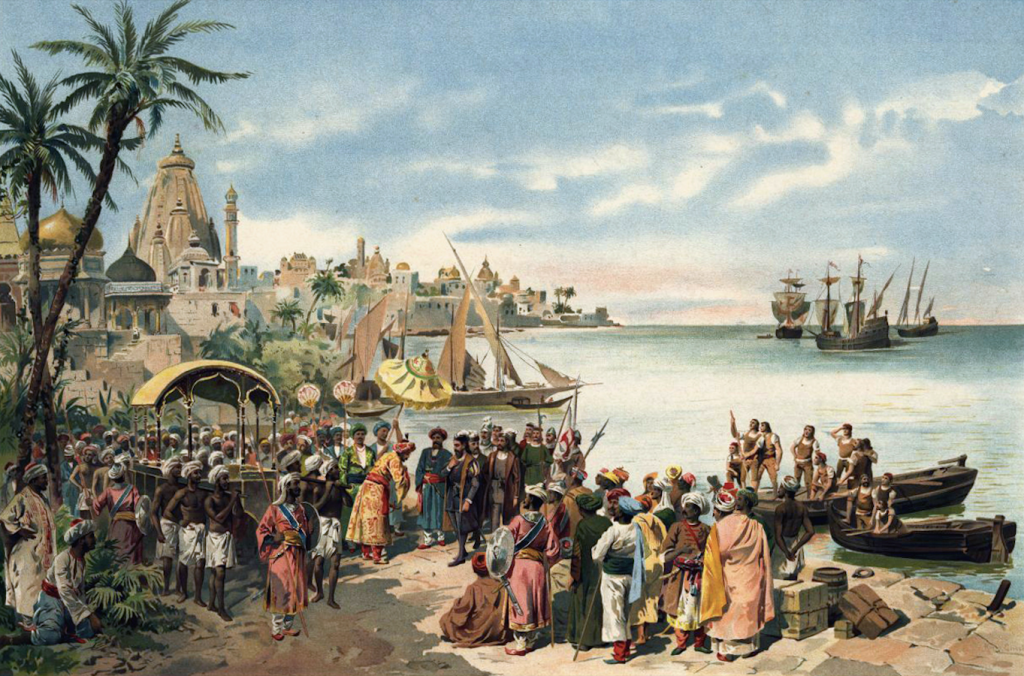
Image courtesy - Roque Gameiro (World History Encyclopedia)

The history and the romance of the drink go back to the voyages the Portuguese took between their colonies, Goa and Brazil. In these long 16th century expeditions, the first cashew apple crossed choppy oceans to reach Goa from Brazil. The false fruit, which holds the cashew nut, was pulped into wine in South American and African countries. The village folk of North Goa went a step further by triple distilling the ferment making into a new version.

(Image courtesy World History Encyclopedia – “Vasco Da Gama arriving at Calicut, India”

Feni somehow had been limited to Goan villagers’ late-night gatherings, friends gossiping at the village square, or a family brought together by music and food. Yet, it was and still remains an integral part of any feast or merriment that happens amidst the village folks.

Goa, at present, has an estimated 30,000 small distillers and six significant players in the Feni industry. Manufactures produce over 100,000 litres in a season.

The Connoisseurs of Feni

For two generations, Cazulo has been taking great care in preserving the invaluable heritage by bottling only the finest Feni from Goa’s tiny yet beautiful state. In South Goa, this family-run enterprise Dona Maria is owned by Wilson and Melanie Vaz in Cuncolim. Today their three young sons, Clinton, Hansel and Donovan, continue the family heirloom forward, upholding the founder’s high standards.


The ’Heritage Spirit’ bounces back with the ‘Spirit’ of Goa Festival

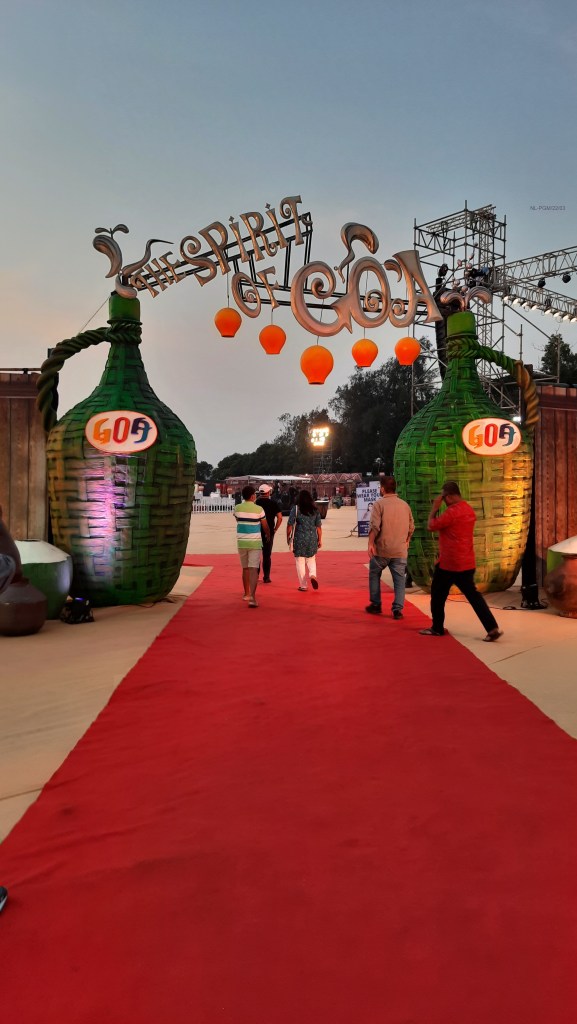
The ‘Spirit’ of Goa was back and rocked the grounds of D.B. Bandodkar Ground in Campal Panjim from April 29th to May 1st 2022. Goa Tourism has a record of putting up a fabulous three-day cultural show every time. The festival showcases the finest spirits crafted by Goa’s home-grown distilleries.

Apart from the sea and beaches, Goa has loads to offer, and this is a platform that demonstrates the various cultural aspects of the state. The prime reason for organising this fine fest is to bring out the true ‘Spirit’ of Goa through music, art and food, which is engraved in the hearts of Goans.

The exploration of Flavours and Sound

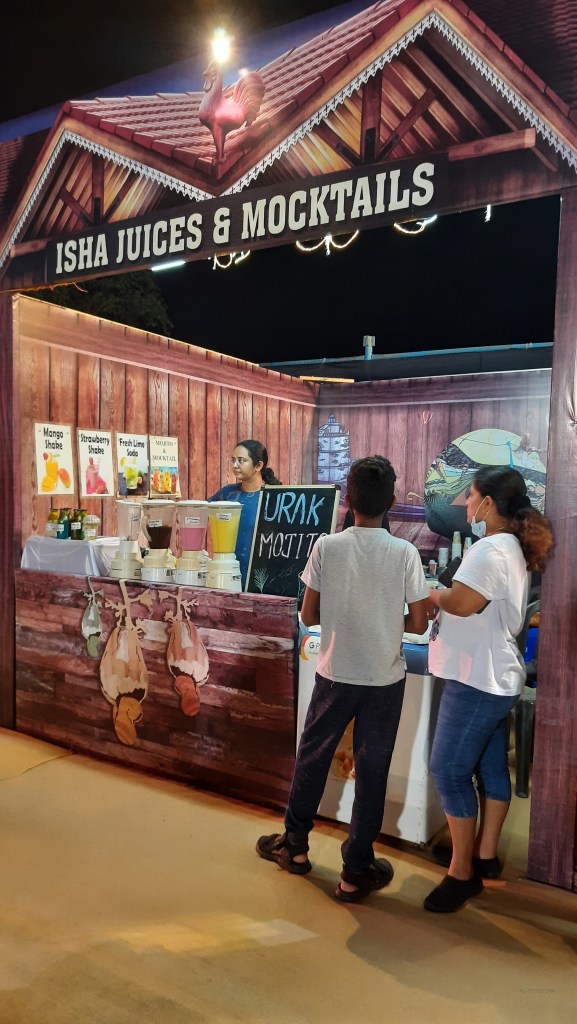
The festival revolves around Goa’s coconut and cashew crops used in various products, cuisine, beverages and handicrafts. People enjoyed tasting some delectable cuisines with coconut and cashew as the key ingredient used in multiple ways. Experts showcased the live distilling process of cashew and coconut juice, also known as Urak. This festival also brought the art of brewing Feni from two of Goa’s favourite food ingredients: coconuts and cashew.

Apart from tasting the flavours of Goa, there were music and dance programs, another aspect that remains in the heart of Goans. The Audience heard some amazing everlasting Konkani and Portuguese classics and some contemporary English Latin mix styles and funky tunes.

The Final Word

The common thread cojoining these timeless country liquor for ages – Feni – has come a long way and now moving into the new century parallelly with other exotic and international liquor brands. With its definitive and organic flavour, mixologist and bartenders are experimenting and inventing unique and delicious cocktails. One can visit the well-known bars and pubs around to experience Goa’s exceptional and surreal ‘spirit’.


NOTE: Are you fond of coastal places? Places with beautiful beaches, abundant sunshine and amazing food! Goa is the place to be. And not just beaches, it has a plethora of destinations worth exploring.
To know more about the sunshine state of Goa, my home city, visit Planet Goa Magazine website to experience the known and unknown of this gorgeous state.
As a writer for the magazine, enjoy more of writings as I go on an adventure exploring the susegad state of India.

Hope is a Decision.

Yesterday, I picked up a book that stirred something deep within me—Hope is a Decision by Dr. Daisaku Ikeda. It’s more than just a book; it’s a quiet, powerful reminder of the strength that lives within us. Dr. Ikeda – a Japanese author, Buddhist philosopher, peacebuilder, and educator – presents hope not as a vague ideal, but as a practical force for living, especially in times of crisis.
“Hope is a flame that we nurture within our hearts. It may be sparked by someone else’s words or actions, but it is ours to protect, feed, and keep alive.” – Daisaku Ikeda
What truly struck me was the active nature of hope. It’s not a feeling that comes and goes; it’s a decision we must make—sometimes every day, sometimes moment by moment.

Picture courtesy – Google Images
Why Hope is a Choice, Not a Circumstance?

When life tests us—through loss, loneliness, illness, or uncertainty—it’s easy to feel powerless. Many of us tend to resign ourselves to despair, believing that our situation is fixed, or worse, fated. But history and philosophy show us otherwise.
Viktor Frankl, a Holocaust survivor and neurologist who wrote Man’s Search for Meaning – shared the horrors of a Nazi concentration camp. He realized one thing that could not be taken from him was his ability to choose his response. He explains, “Everything can be taken from a man but one thing: the last of the human freedoms—to choose one’s attitude in any given set of circumstances.”
This echoes Ikeda’s belief that every person, no matter how grave their suffering, has the power to elevate their life condition. He writes that our inner determination can transform even the darkest moments into opportunities for growth.

Crisis and the Courage to Hope

We are currently navigating a global pandemic—a crisis that has disrupted lives, challenged mental health, and left many feeling isolated. But just as the lotus blooms from muddy waters, hope can arise in the most unlikely places.
Ikeda says: “As long as we have hope, we will never be defeated. Hope is a decision—a decision to believe in ourselves, in others, and in the possibility of change.”
This idea isn’t limited to Buddhism. Marcus Aurelius, a Stoic Roman emperor, urged himself to wake each day and accept reality with grace and clarity. He said, “You have power over your mind—not outside events. Realize this, and you will find strength.”
Hope doesn’t mean ignoring pain. It means confronting reality with the firm belief that we can create something better from it.

What Does Hope Look Like?

Hope can be found in many forms:
– In a friend’s encouraging message when you’re feeling low.
– In the tree growing through concrete, reminding you that life finds a way.
– In the stories of people who rise again after devastating losses.
Dr. Ikeda shares stories of ordinary individuals who, through sheer courage wisdom and compassion, extracted from faith, transformed their circumstances. Whether it’s a war widow raising children with dignity, or a survivor of disaster who becomes a beacon of support for others, these stories show that hope is action, not abstraction.

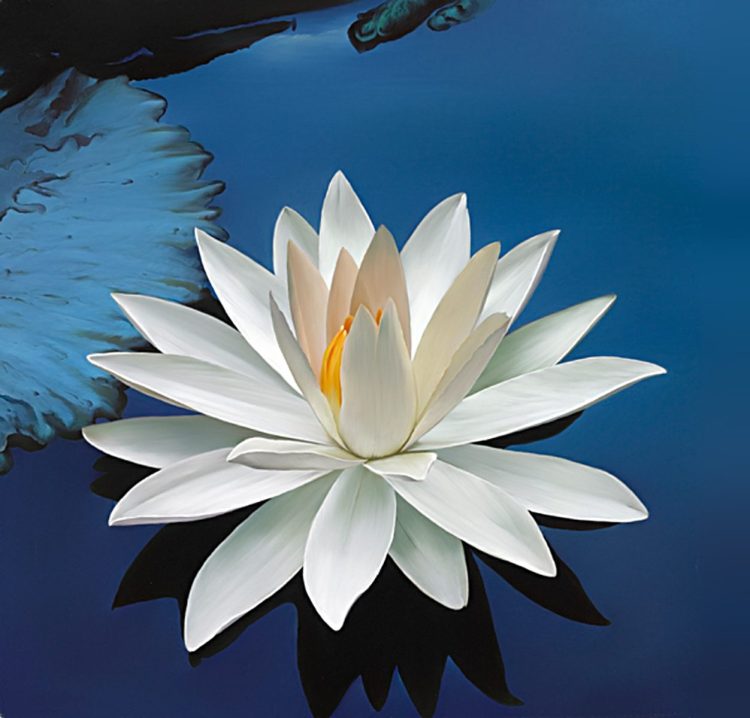
A Lotus blooms in mucky water. Yet it is beautiful and filled with fragrance.
A Spiritual Awakening

Hope also requires inner work. In Nichiren Buddhism, which Ikeda practices and many like him in 192 countries—this means pure hearted prayer of Nam Myoho Renge Kyo, self-reflection, and striving to become the highest version of yourself. Nichiren taught that every individual contains the seed of enlightenment within. When we tap into that inner strength, we transform both ourselves and the world around us.
“A great revolution of character in just a single individual will help achieve a change in the destiny of a society and further, will enable a change in the destiny of humankind.” – Daisaku Ikeda
Similarly, Rumi, the Persian mystic poet, wrote about inner transformation: “Try not to resist the changes that come your way. Instead, let life live through you.” – Rumi

Are You Hopeful?

So, I’ll ask you: Are you hopeful?
What fills you with hope? Or have you unknowingly surrendered to a world of despair, where violence is normalized, and injustice feels like background noise?
As Dr. Ikeda says, “The place where you are now is where your mission begins.”
We don’t need to accept the world as it is. We can reshape it, but only if we start from within.

Final Reflections
In times of crisis, the easiest path is resignation. The harder, braver path is to choose hope again and again, no matter what. But it’s in that difficult choice where we find real freedom—and real peace.

You are not alone

Philosophers across centuries—from Stoics to mystics to modern peacebuilders—all whisper the same truth: You have the power to rise, to hope, and to create change—starting with yourself.
So, the next time life knocks you down, ask yourself not “Why me?” but “What can I create from this?”
Let hope be your answer.

No one is ever lost:- Igniting hope into lives

Human beings are perhaps the most vulnerable species when it comes to the fight for survival. Across ages, eras, and centuries, whenever a person has lost something precious, it often traces back to one thing — the loss of the will to live. And yet, time and again, people have found the strength to rise. That strength doesn’t come from magic or miracles, but from a timeless, powerful source: love and compassion.

Picture courtesy – Google Images
The Magical Pool of Love and Compassion

Two simple words — yet they hold the key to universal healing.

This reservoir of love and compassion is like an oasis for all the souls lost in the harsh desert of life. When someone feels isolated, abandoned, or stripped of belonging, it’s not the external circumstances but this internal void that causes them to break.

But I’ve seen — and studied — countless cases where people have overcome even the most confounding challenges. What saved them wasn’t divine intervention, but something dormant within them that awakened precisely when it was needed most.

That inner awakening infused them with the strength to endure, to fight, and to heal.

Picture courtesy – Google Images
The Teachings of Compassion

Even Buddha, in his teachings, spoke of this powerful inner source. Love and compassion are not just virtues — they are the essence of the soul. They empower us to keep moving forward. It’s incredible to witness the depth of spiritual and emotional strength humans are capable of when truly tested.

Nichiren Daishonin, an 18th century monk who taught the Lotus Sutra – teachings of Shakyamuni – emphasized the significance of love and compassion. He viewed them as essential for individual and societal flourishing. He believed that compassion is the foundation for both personal growth and the betterment of the world. His teachings extend beyond personal relationships to encompass a universal love and compassion for all sentient beings. He saw this as a vital step in the pursuit of world peace for the future of mankind.

Following his teachings, Dr Daisaku Ikeda – a Japanese author and Buddhist practitioner – explained, “Compassion is the very soul of Buddhism. To pray for others, making their problems and anguish our own; to embrace those who are suffering, becoming their greatest ally; to continue giving them our support and encouragement until they become truly happy―it is in such humanistic actions that Buddhism lives and breathes.”
These are not just beautiful words. They reflect the core purpose of our existence. When we truly understand their meaning, we uncover the secret to living a life of peace and harmony.

The Modern Wanderer

Today, many of us have become emotional wanderers — lost souls in search of something we can’t quite name. We’ve drifted away from our own humanity, replaced emotion with routine, and lost touch with the warm, flowing essence of compassion.

Our inner rivers have run dry.
Where once flowed emotion and connection, there is now silence.
But the question remains — can we refill that river?
Can we summon the rains of empathy and kindness once more?
Can we rekindle the human spark that once made us feel alive?

Reigniting the Human Spirit

Yes. Absolutely, yes.
With self-belief, the warmth of love, the grace of compassion, and the support of others, we can heal even the deepest scars.
This isn’t a new idea — it’s as old as humanity itself. And it will continue to be our greatest hope, for as long as we walk this Earth.

A Personal Mission

I don’t write this because it sounds poetic.
I write it because I’ve lived it.
I’ve seen people rise. I’ve experienced the healing power of compassion. And I strive every day to become a kind of moisturizer for the dried souls wandering this land.
The journey is not easy.
The path can be rough.
But it is not impossible
,
To win, for love.

And I truly believe that within every human being lies the potential to make the impossible possible.

Tolerance – Acknowledging and respecting dignity of all lives

I have always been curious and keen to find answers to a very stringent and unnerving logic behind “intolerance”. Honestly speaking, I personally never understood this subject in the first place. Meaning, why is there so much intolerance among individuals for very minor and petty issues! Whereas the intolerance should exist against much greater and harmful issues to entire human race.
We are different in way of birth, gender, living environment, value systems, etc., that makes us who we are. Just because there is difference in the way we think, speak, appear
does not mean one is less than the other. It is always good to put your point forward and have a healthy argument. In noway it should lead to verbal or physical violence, hatred or despising a community/religion all together just because one individual thinks the opposite.

Being born in a democratic and secular society, we all have the right to express ourselves. And we all should respect each individual’s opinion, only until those expression start becoming that of extreme violence and hatred. When we make ourselves aware of basics of humanism while practicing and study humanistic philosophy, we start to clear the clouded air in our minds that blocks rational thinking. While study various books on Buddhist Humanism, I came across a wonderful quote from an avid Buddhist philosopher, educator and author – Daisaku Ikeda. He writes – “The Lotus Sutra is a teaching that sees the infinitely respect worthy Buddha nature existing within each person’s life. Based on this standard of value, any other system of thought that teaches the dignity of life deserves our respect as well. On the other hand, we can never accept a philosophy that denies the dignity of life. This is the true spirit of tolerance and compassion.” — Living Buddhism.

As I mentioned earlier, should we show tolerance towards intolerance? Clearly, the answer is No. The things which are inhumane and harmful to anyone should never be tolerated.
There are limits then to tolerance. But how do we understand that thin line of difference?Mr. Ikeda has beautifully explained that the line that should not be crossed is that of ‘disrespect for the dignity of all life’. So long as the basic premise is – that all life is respect-worthy – is universally agreed upon, we can and should tolerate a wide variety of thinking and behavior—a kind of tolerance-with-limits.

I believe tolerance cannot be put in better words than the above. The current on-going global crisis is a harsh test given to mankind. It is testing humans of tolerance levels, coexistence, and cooperation. This is the moment to transform oneself and become better humans. And also, at the same time, accept the fact that we cannot ignore each other, take each other for granted, use each for self benefit, or even go to level of killing each other. This is the time we get together to pass this test of time that humans are meant to coexist.

Pic courtesy Google Images

Let me close with another piece from my study. In his September 1993 Harvard University lecture, Mr. Ikeda spoke of tolerance, offering the example of Shakyamuni Buddha, who was considered a “master of words”: Why was Shakyamuni able to employ language with such freedom and to such effect? What made him such a peerless master of dialogue? I believe that his fluency was due to the expansiveness of his enlightened state, utterly free of all dogma, prejudice and attachment. The following quote is illustrative: “I perceived a single, invisible arrow piercing the hearts of the people.” The “arrow” symbolizes a prejudicial mindset, an unreasoning emphasis on individual differences. India at that time was going through transition and upheaval, and the horrors of conflict and war were an ever-present reality. To Shakyamuni’s penetrating gaze, it was clear that the underlying cause of
the conflict was attachment to distinctions, to ethnic, national and other differences. (My Dear Friends in America, third edition, p. 340).

Hence, true Tolerance, requires immense exertion on our part to overcome our own prejudicial thinking, our own attachment to differences. Such effort is the basis for establishing a society rooted in peace and human rights.

(Disclaimer – The opinion expressed are mine, mostly extracted from experiences, study of philosophy and research. They are neutral and in no way pointing to any individual or religion or a way of thinking. This post is meant to ignite positive thinking and allowing reader to imbibe the concept much deeply and clearly, and with an open mind)

As good as it gets when the worst hits

As I sit in the corner of my favorite sofa thinking while surfing through the past, I realize why the hell life meanders in the most obnoxious directions. All my life I’ve been very practical, been logical and ethical in my actions, have been compassionate and empathetic towards the world around me. I never believed in destiny because I believe in writing my own. But, Yes, I do believe in Karma, very strongly and that, that one lives the outcome in the very same life. It has been understood that life is an amalgamation of the most arid and varied series of pleasant/unpleasant incidences, which many a times makes one just sit and ponder about the mysteries of creation of such incidences. And it still remains a
mystery to me.

Pic courtesy Google images

The sweet mellowness of being together in the most down-sided situation has been, I believe, a blessing but sad to say a past phase of life. When a vile intended escapade occurs, that to into a calm peaceful domain, it has the capability of disintegration, bringing in shallowness and also shattering the very existence of Good Karma. Such incidences makes one questioning the very existence of Life with Good Karma.

Life has shown the most abominable turns. But by far the most unacceptable one was when ‘He’ decided to steal away the one soul that loved, struggled, faced harshness from all angles but still had the courage to live it the right way. It was destined but it happened so of sudden and that too at a time when he was just beginning to Live Life. The most harmless peaceful soul that unfortunately had to suffer the pains of the unwanted… and then just decided to give-in to ‘His’ decision. A devastating truth of life that everyone comes face to face at one point in time, but always the most unreal fact.

As the law commends Life should go one… one can still try to move on despite the difficulty in acceptance. But when one has the incorrigible ready to explode with full vile intentions, how does one expect the victims of the circumstances to react or respond. A perfect melodrama, while and when the traveling soul is just about to rest in peace… what a shame. Such types have the audacity to be so inhumane that they forget the intensity and vulnerability of the situation. How do the shock-stricken souls think of surviving the rest of day/s with inner peace while still trying to adapt to their loss.

This makes one think… how does Good Karma result in Goodness… when one has to face the maliciousness of a consort to such an extent. Disrespecting the soul that has flown away, disregard to the fellow members and being as brutal with words as possible filling the air with atrocious negativity, suffocating all beings within the circumference. These types have no humility in character, no self-realization of the wrong doings…. one wonders how do they survive an entire lifetime or even live a day through with their heads held high, no regrets and with no shame at all.

Do the great preachers have an answer to this or do they still suggest the sufferers to go into a Buddha state and be calm, ignorant…. and just keep on living, grueling with the heart-wrenching memory of the episode. Once, smiling faces now frowned-forever faces look up for justifications, answers to the unsolved riddles. Do they really deserve this? Or is it the repercussion of the decision taken in-favor of adding life into existing ones with good soulful intentions…. or just being too humane…. or an effort to put a smile on the face of the good soul that suffers.

It’s so strange that one comes face to face to life-altering situations that have the power to transform the most optimistic ‘love to live’ soul into a melancholy, heart-broken, loner, being drifted towards the darkness. The struggle to stay afloat is indescribably immense. And it really saddens to be witness to it, helplessly and hopelessly. What is it? Is it being victim of your own Destiny, or suffering the outcome of your own Karma, good/bad…… OR platonic foolish human behaviors that make mankind suffer It’s suffer. It s difficult to say, really!

Embracing Change

It has always been my endeavour to do something that can somehow bring about CHANGE. I prefer starting with small steps than take big leaps. Recently I have been urged by my soul to bring people together…which I felt have distant, with time due to circumstance or pure ignorance. Well this includes me too. This awakening happened very recently. Why it happened, how it happened. Well, I am still trying to figure it out. But it has happened and it has happened for good. Though, I consider myself as one of the culprits who got so preoccupied in the life’s ‘Rush Hour’ that I forgot that there is life beyond the desk, the
laptop & the never-ending meetings.
Being in the field where we call ourselves “Communication Specialist”, I myself became so uncommunicative to people outside the circumference of my work world; people who are my own – people who are my family, some who missed me when I was never there, few who love for who I am and still forgave me for my no-involvement. It has been a self-realisation and I feel sorry for being so indifferent to all of it.
I feel something inside me changed. The change is so drastic that it has urged me,
motivated me and is now pushing me off the ledge to work towards bringing atleast
my own together. One of Mahatma Gandhi’s profound and deep quote is – “Be the change you wish to see in the world.” I couldn’t agree more and my totally implementing it in my life as well. Though I’ve always have worked in a fashion that
has brought about changes, till now, to everything that had to do with career accomplishment. But this time it will be different. The change will happen but in My World and I WILL make it happen, whatever it takes.
I have just about managed to take the first step successfully. With this I have understood that, people who love me have understood my intentions so clearly. Their willingness to support me has given me the strength to walk tall, all the way through. And I just hope it continues and things in my world become more colourful. That is something I really pray for, from my heart.
Well another thing that really surprised was those few who have suddenly become so involved. They were always there but I only failed to notice there love & affection for me. Infact, I don’t even remember interacting with them on a daily basis and today, we
just can’t stop. It’s funny, it’s weird but you know what… it makes me happy, really very
happy.
If at the end of the day I am able to bring change in people by just a small initiative, I believe I can do a lot more by being more involved and be part of my world that was less visited.

(written by 10-years-ago-version of myself. Now I have progressed, matured and seeking the path of enlightenment).

The Magnificent Goa Carnival

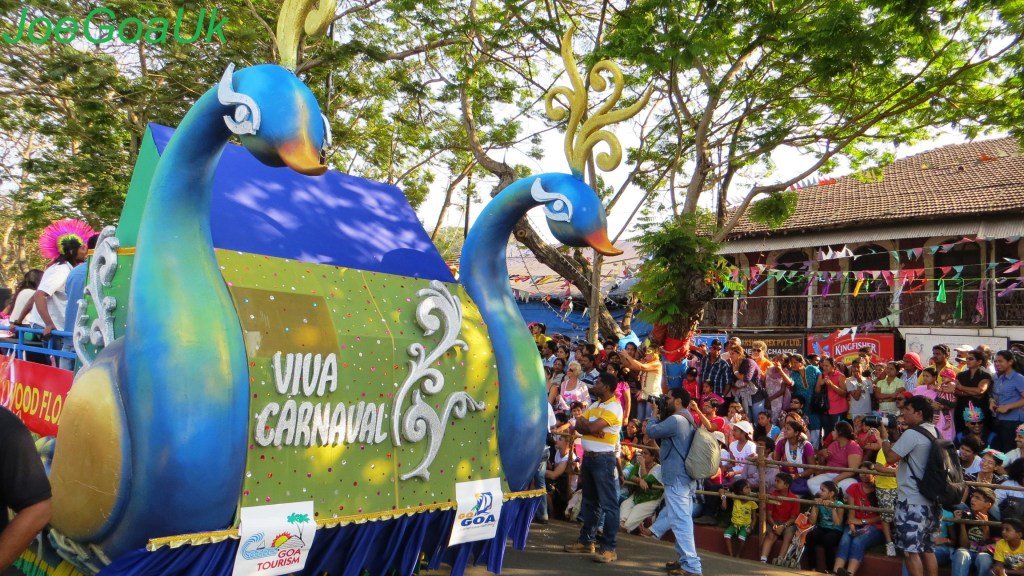
Carnivals have been a high-pitched celebration of a coastal susegad life. These vibrant, colourful events occur in their traditional way around the world, but truly iconic ones happen only in – Goa and Brazil. The Goa Carnival is a legacy that has been passed by the Portuguese ancestors. The Carnival is unique to Goa and is being celebrated ever since the Portuguese introduced it in the 18th-century. This “Carnaval” as the Portuguese called it, is nothing but four-days of merriment making that include eating, dancing and having a blast.

Although the Goa Carnival is comparatively smaller in scale, however, it is one of the largest Carnivals celebrated in India and a single one in Asia. This historic and electrifying festival takes place within the beautiful cities across Goa, where the true Goan spirit comes alive. Celebrated every year with a lot of zeal, the Carnival gets the highest visitors from around the world, to bask in the glory of this four-day-long festival.

A glimpse into the milieu of the Carnival

The Goa Carnival marks the festivities before the month of ‘Lent’, which means – ‘fasting or self-denial from meat’. It culminates into Easter and is significant for the Christians.

The Procession of Festival

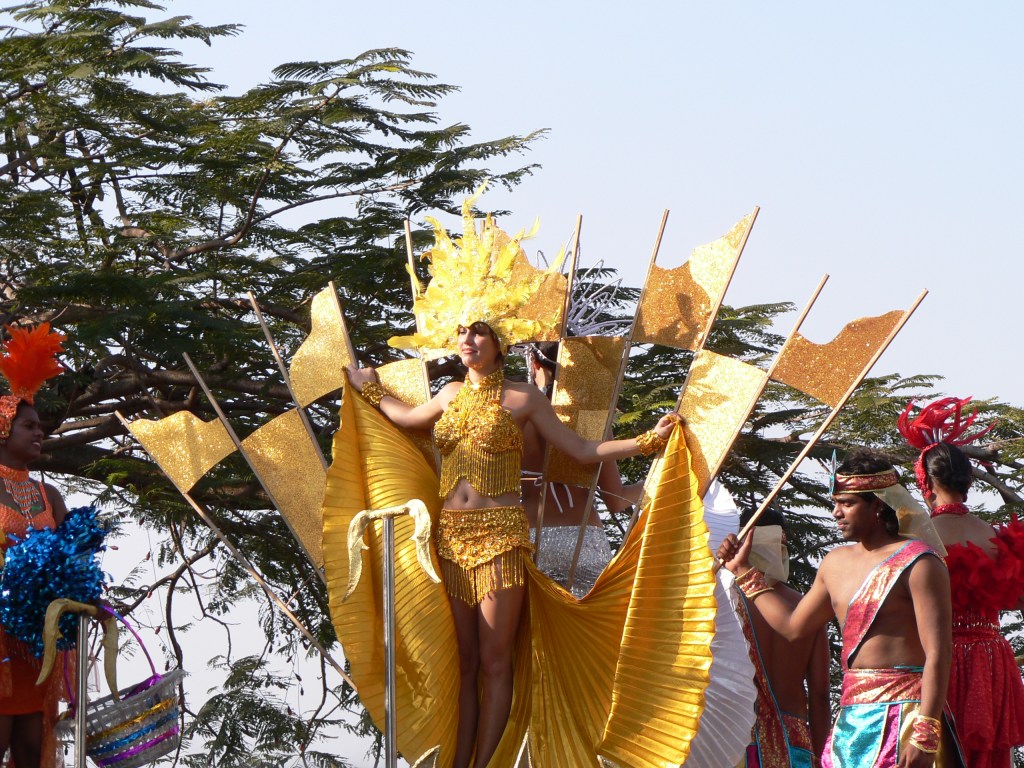
The Carnival begins in the evening with a huge parade led by King Momo and the performing dancers and musicians. The participants adorn colourful costumes and enact characters of fortune-tellers, vendors, women, and older men. The procession follows down the main streets of Panaji, Mapusa, Margao, and Vasco.

For those who have a passion for performances and dancing and don’t shy away from the crowds, get the opportunity to dress up in the most beautiful red and black outfits. Wearing masks, they dance the night away along with with various musicians and performing artist. These performances are an integral part of the grand colourful procession that happens in Panjim, all the way down to the Miramar Road. King Momo’s crowning ceremony and the Red and Black Ball are the main attractions at the Goa carnival festival. The festivity is marked with drinking, dancing, and lots of music till late into the night before the dawn of ‘Ash Wednesday’, which commences the ‘Lent’.

The Speciality of Goa Carnival

The one-act folk plays called the ‘Khell’ or ‘Fell’ are a definitive focus of this grand Carnival. During the Carnival held in Chandor, performing actors walk around the village singing Intruzachim Geetam or Fella-Gitam accompanied by musical instruments. The sound of Drums, Violins, Ghumats – a Goan percussion instrument – and cymbals fill the air with music and melody. These performances are a must-see, quite amusing, and an experience to remember. The Fell, with its acerbic and sardonic censure, meant to correct human foolishness. Then there is the Dholak – the person who directs the one-act who narrates the story, while the whistle of the producer (mestri) serves as the curtain-raiser. The tourist gets an added benefit as few hotels organise special celebrations for their guests during the Goa carnival. Since the Carnival happens during the peak season, hence visitors planning their visit need to book tickets and hotels much in advance as most of the places are sold-out.

Au revoir

The preparations for the Carnival begin from December. A week before the Carnival, few boys and girls dressed up in masks call upon their friends while playing on the banter. This activity is known as ‘Assoltes’ where the guests are entertained with drinks and snacks to set the mood. The festivities are marked by drinking, dancing and music that carry on till dawn.

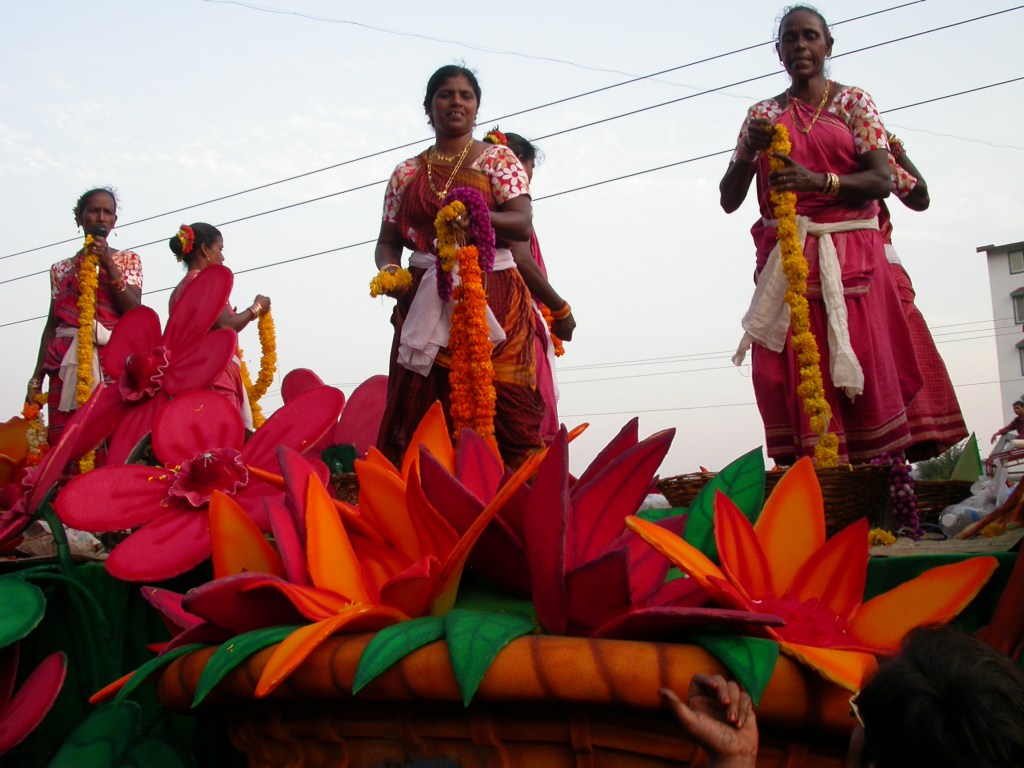
Witness the colourful and beautifully decorated floats during the parade, and add to the cheer. As per tradition, bistros and other cafeterias prepare their finest fish and meat dishes. Guests have the option to participate in various competitions that are organised, or just have a good time gorging on authentic Goan cuisine, especially seafood, and drinking Feni. The fashion shows, DJ Nights, short plays, add to the galore of the entire festivity.

The four-day of joyful, exuberant celebration amidst the music and fun-loving people of Goa reaches its climax during the four-day Goa Carnival celebrations. It is an annual event that the entire Goa and beyond look forward to and prepare for the whole year. So as we approach the winter season, the preparation will soon commence for this grandeur of an affair. If you haven’t experienced it yet, don’t miss it this time.

God’s own Residence (Rishikesh)

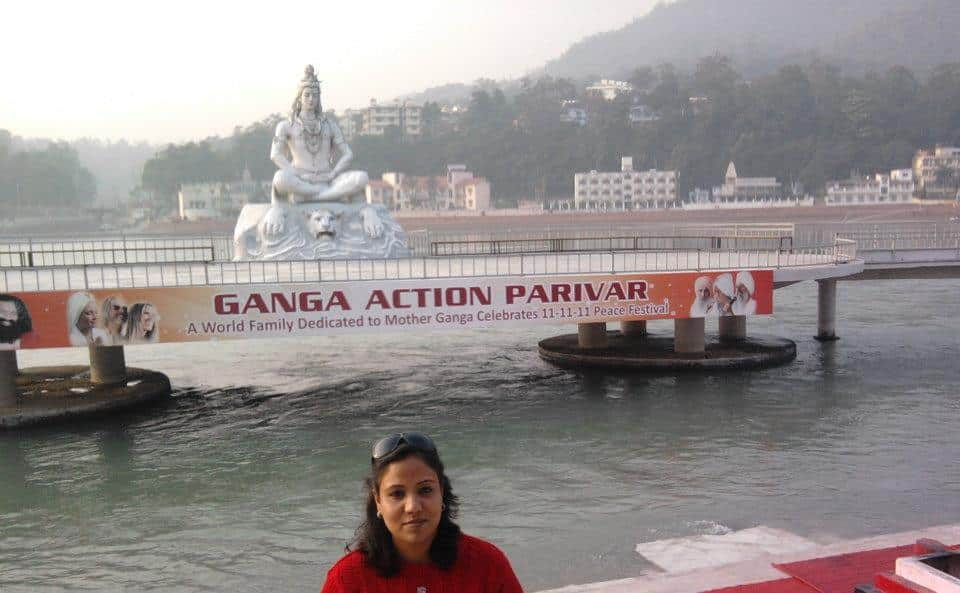
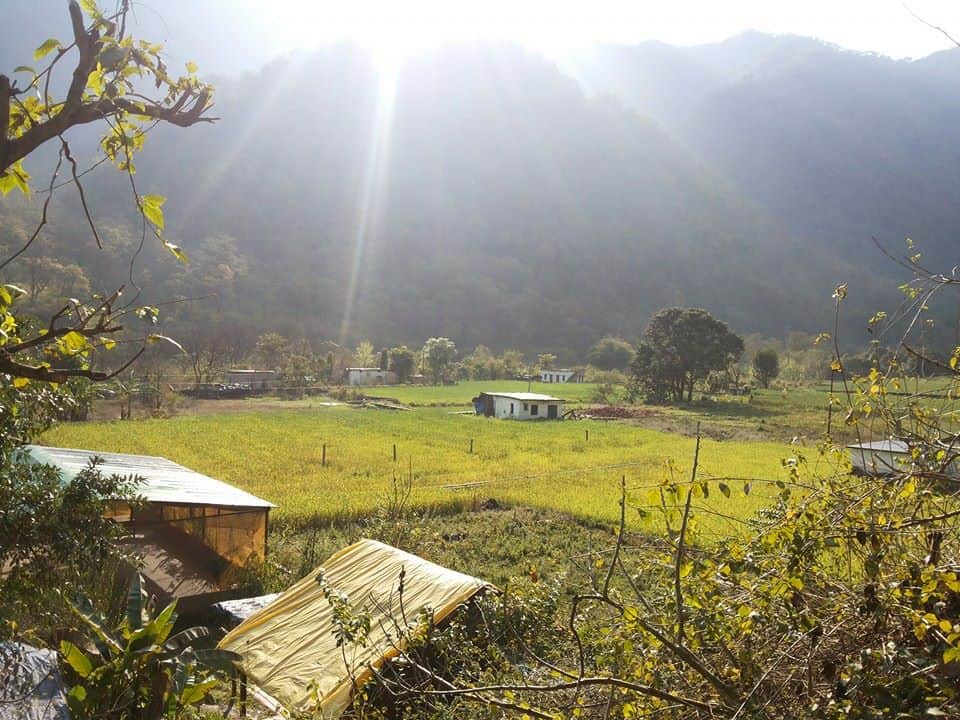
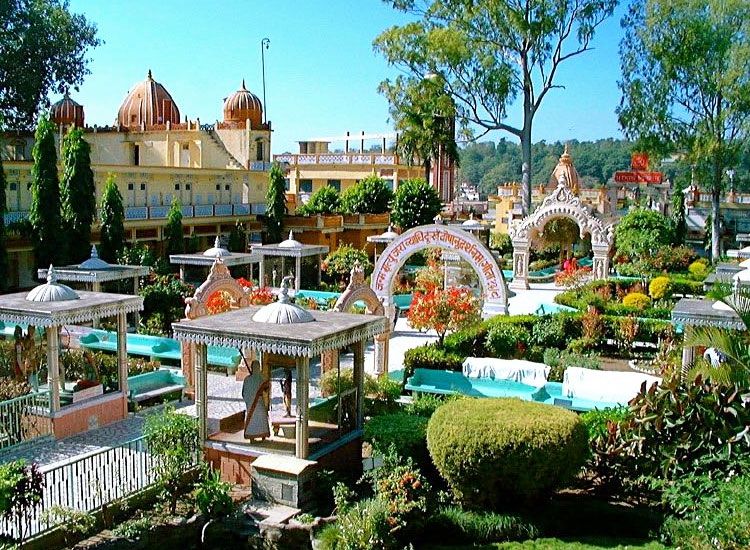
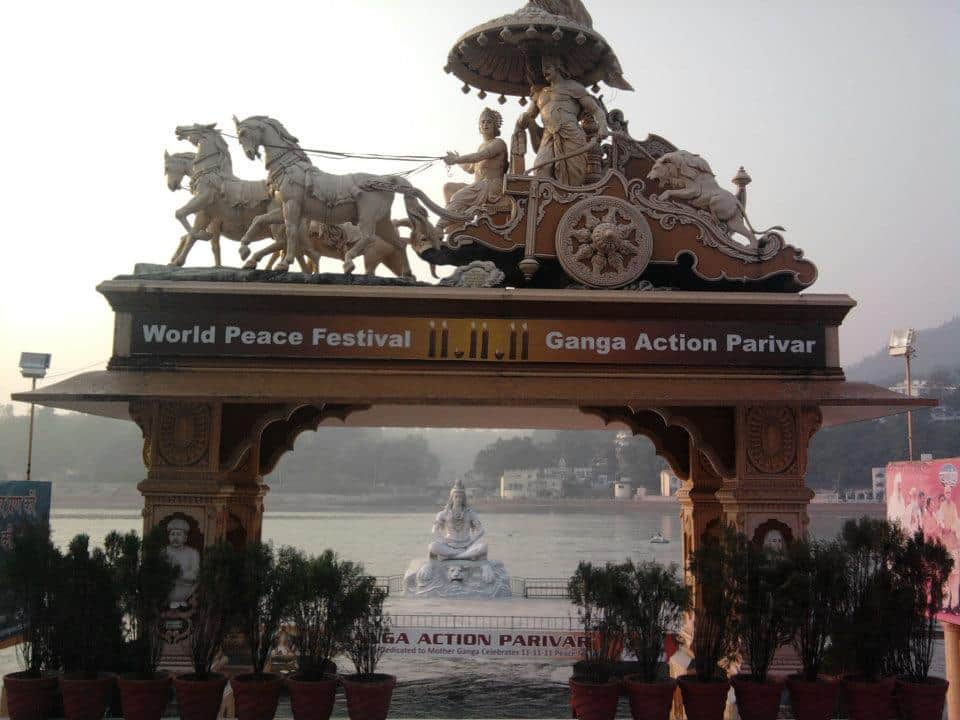
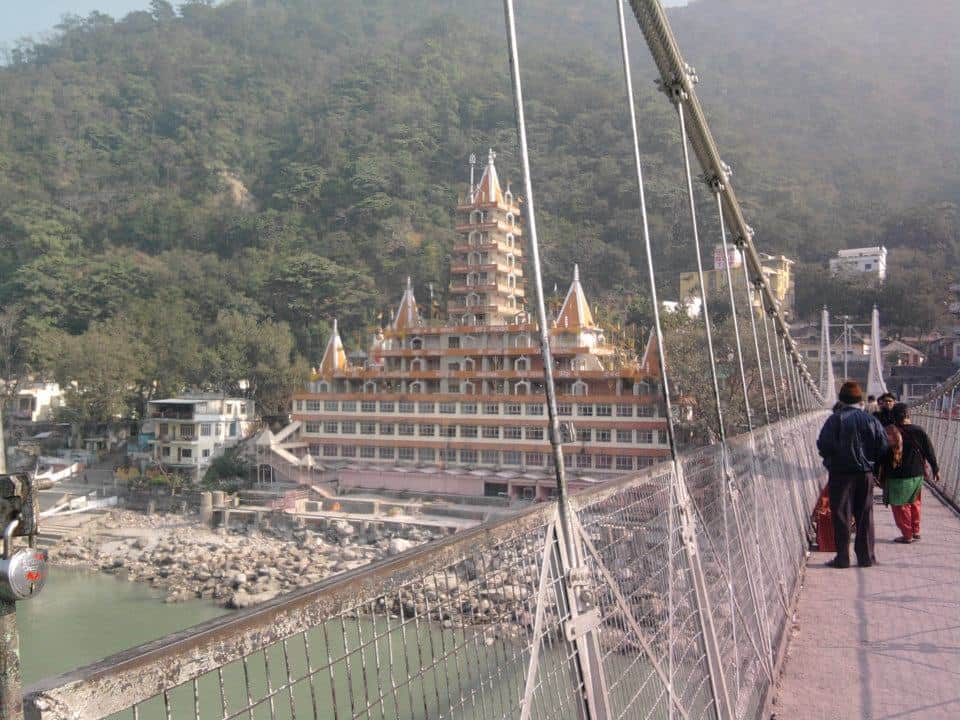
Yeah, I would call it God’s abode… because it really is. Splurged with only Temples, each one an architecture master piece, and ashrams. And ofcourse the mighty River Ganga, in it’s true form is so empowering that it definitely makes its presence felt. The freezing mud green water of Ganga with white foamy rapids is a vision in itself.

Pleasant winter afternoon at Rishikesh Valley Resort

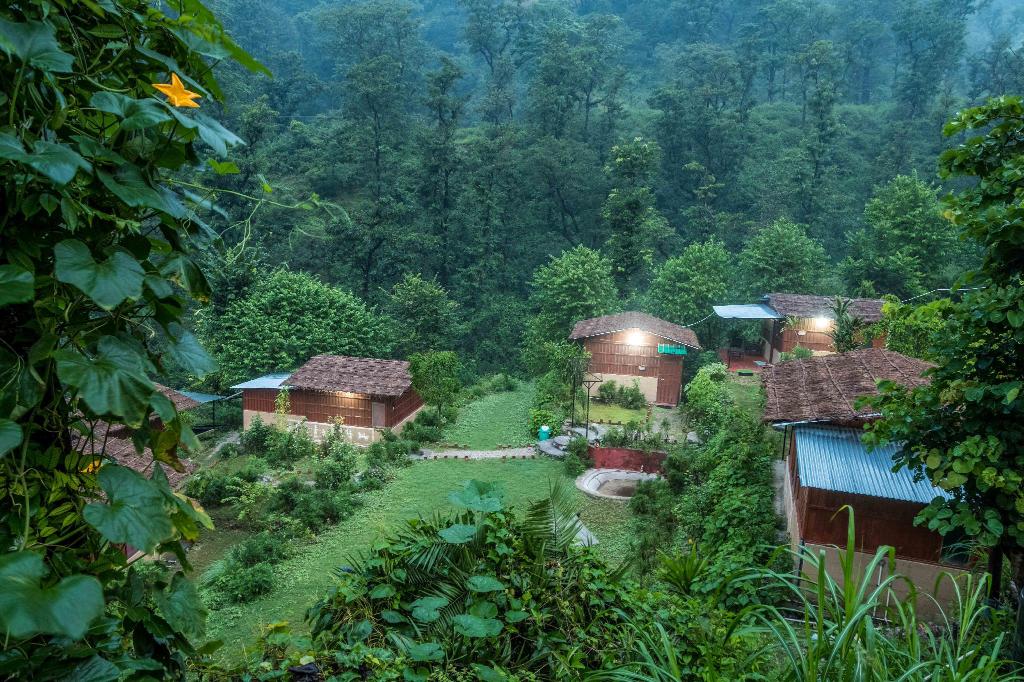
Our haven for the visit was Rishikesh Valley resort, located 10km from Laxman Jhula. In the lap of nature, resides this beautiful, all natural material made abode that does the
detoxifying effect to your soul. The lush green hills around and the Ganga flowing right outside the resort making it a perfect getaway for the souls who appreciate and cherish a natural-non-luxury-serene-tranquil place. Ours was a typical mud hut with basic but very clean and comfortable amenities. Living in such places shows how much one respects and acknowledges god’s gift of nature.

River Ganga flowing in front of Rishikesh Valley Resort

Surrounded with lush greens, beautifully maintained garden and able to enjoy the fruits of nature right from its lap… is inexplicable. It’s an experience in itself. And as I said, you really don’t have to be a strict religion follower to visit such a holy place. Anybody and everybody who loves exploring and looks for a serene place with natural beauty will find enough to discover and explore even in the city of temples.

I recommend Rishikesh as a must-visit place especially to the stay in Rishikesh Valley Resort. You are definitely going to feel the divinity and peace that every soul needs.

A room with a view – Lansdowne, Uttrakhand

Just picture this…….a room in a resort that so aptly located on a cliff, overlooking a
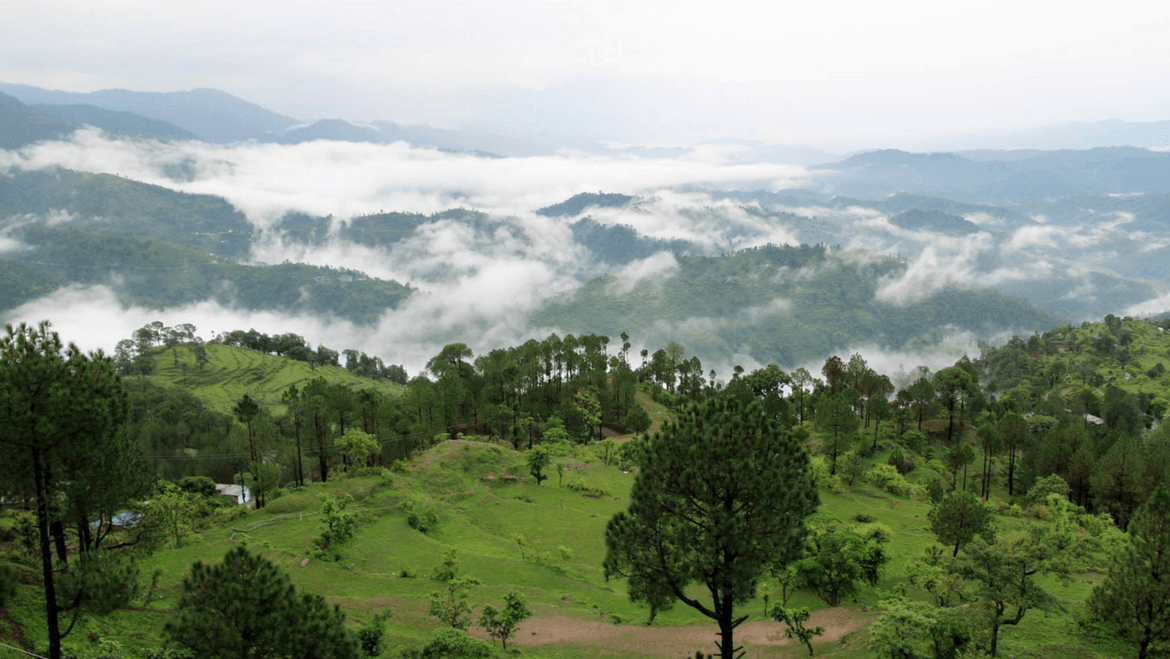
beautiful valley covered with Himalayan Garhwal foothills, approximately 6000-7000km above sea level. The early morning brings in the sun that brightens up the entire valley. You can see as far as your eyes could, into the vast expanse of this beautiful valley, showing off those foothills with some amazing shades of green and blue. The place has a beautiful calmness about it that heals you from inside and its landscape, still untouched by
the urban madness. The pine forest that surrounds the resort and also covers the whole valley is divine. Just the sound of birds chirping, wind blowing and hustling of the Pine leaves (sometimes sounding like water flowing), is what you hear.

Then, just few minute later the cool mountain breeze would blow-in those fluffy dark clouds making the afternoons really cool, rainy, misty & amazingly fresh as the mornings. Those white creamy clouds would settle down below in the valley just to add contrast to its greenness. The wind will then make them rise up and cover the whole valley, as if the sky as dawned upon the earth with its whiteness. Suddenly you can see them flowing into your room from the window, splashing you with its cool mistiness….. Just breathe taking.

The nights were like you’ve never seen before. The twilight drives the clouds away just to welcome the brightest stars that lit up the entire night sky. Its magical…making you so lost that you just don’t feel like recovering from. And when you look down into the valley, you can actually see a replica of the night sky happening. The houses in the valley with lights twinkling away in the darkness of the night, paints a perfect picture of the night sky right in front of you….Unbelievable.

Far away at the horizon you see the lightening storm brewing, in a way distracting the calm brightness of the star lit night sky. This amazing work of art is worth a watch and never to be forgotten.


Does this description mesmerize you or what!!! Well… I was privy to all of this and a lot more right here…in Lansdowne.